Guide to B.C. Driver’s Licence Classes: Class 5, 7, 6, and 8
Choosing the right B.C. driver’s licence class depends on what you want to drive and where you are in the licensing process. Class 5 and Class 7 cover most passenger-car drivers; Class 6 and Class 8 apply to motorcycles. This guide explains what each class means, how drivers move between stages, and when a commercial class or endorsement may be needed.
How B.C. driver’s licence classes work
A licence class describes the kinds of vehicles you are authorized to drive. It does not, by itself, tell you whether you are a learner, a novice driver, or fully licensed. For example, Class 7 is associated with the graduated licensing stages for passenger vehicles, while Class 5 is the full passenger-vehicle class.
Motorcycle licensing uses a separate pair of classes: Class 8 is the learner stage and Class 6 is the full motorcycle class. Commercial vehicles have their own classes, generally numbered from 1 to 4. Your licence can include more than one class, but you must meet the requirements for each one.
A class is also different from a restriction or endorsement. A restriction can limit when, where, or how you drive. An endorsement authorizes a specific additional activity or vehicle feature, such as operating a vehicle with air brakes. Check the information on your licence and confirm any unclear condition with the Insurance Corporation of British Columbia (ICBC).
| Licence class | Main purpose | Typical progression |
|---|---|---|
| Class 7 | Passenger vehicles under the graduated licensing program | Learner licence, then novice licence |
| Class 5 | Full passenger-vehicle licence | Usually follows the Class 7 stages |
| Class 8 | Motorcycle learner licence | Motorcycle learner stage |
| Class 6 | Full motorcycle licence | Follows the applicable motorcycle learner requirements |
| Classes 1–4 | Commercial vehicles and passenger-carrying work | Requirements depend on vehicle, use, and class |
This is a starting point, not a complete vehicle-eligibility chart. Towing, vehicle weight, passenger capacity, air brakes, and the vehicle’s actual configuration can affect what licence or endorsement you need. When in doubt, check with ICBC before driving a vehicle that falls outside an ordinary passenger-car situation.
If you are starting from the beginning, Graduated Licensing in British Columbia: Learner to Full Licence explains the broader passenger-vehicle pathway. For a quick comparison of the two passenger-car classes, see Class 5 vs Class 7 in B.C.: Upgrading Past Graduated Licensing.
Class 7: the passenger-vehicle learner and novice stages
Class 7 is the class most people encounter when beginning to drive a passenger vehicle in B.C. It is connected to the province’s graduated licensing program, which gives new drivers time to practise before they move to a full Class 5 licence.
Class 7 learner licence
The learner stage is commonly called the L stage. A new driver generally needs to pass the required knowledge and vision screening before receiving a learner licence. The licence comes with restrictions intended to keep practice supervised and reduce distractions.
A Class 7 learner must drive with a qualified supervisor who meets the current requirements. The learner must also follow the conditions shown for their licence, including restrictions on passengers, alcohol and drugs, and electronic devices. The learner display sign must be shown as required. These rules apply even when the driver is practising with a family member or using a familiar vehicle.
Before a learner drives, the supervisor and learner should agree on the route, the practice goal, and who is responsible for the vehicle. A quiet residential street may be appropriate for early practice, while higher-speed roads, busy intersections, and unfamiliar routes are better introduced when the learner is ready. The supervisor must be prepared to intervene, not simply sit in the passenger seat.
Class 7 novice licence
After meeting the learner-stage requirements, a driver may take the road test for the novice stage. Passing moves the driver from the learner stage to a Class 7 novice licence, often called an N licence. The driver can then drive without the same learner-supervisor requirement, but must continue to follow novice restrictions.
Typical novice conditions include displaying the N sign, limiting passengers in specified circumstances, and not using electronic devices while driving. Alcohol and drug restrictions also apply. The exact conditions matter: a novice driver should not assume that a passenger is permitted simply because the passenger is a friend or family member. Check the current rules for exceptions and the circumstances in which a qualified supervisor may be required or allowed.
A road test pass does not mean all graduated licensing conditions disappear. The novice stage is a separate period of driving under restrictions before a driver can qualify for a full Class 5 licence. Serious driving offences or certain prohibitions can affect progress. For teen-specific details, see Graduated Licensing Rules for Teen Drivers in B.C..
Practical habits during the Class 7 stages
The best way to use the learner period is to practise a range of ordinary driving situations gradually. Include intersections, lane changes, parking, school and playground areas, changing weather, and roads with different traffic levels. Keep practice focused: a short session working on one skill can be more useful than a long drive without a plan.
New drivers should also build habits that remain useful after graduating:
- Scan ahead and check mirrors regularly, rather than focusing only on the vehicle immediately in front.
- Shoulder-check before moving laterally, turning, or leaving a parked position when appropriate.
- Slow down early for hazards, crossings, and changing road conditions.
- Leave enough space to stop safely and avoid following too closely.
- Put away and silence devices before starting the vehicle.
- Ask the supervisor to explain decisions calmly after the vehicle is parked.
The learner and novice stages can feel restrictive, but they provide structured time to develop judgment before driving without those conditions. A driver who is unsure whether a restriction applies to a particular trip should check the licence conditions and current ICBC guidance before driving.
Class 5: the full passenger-vehicle licence
Class 5 is the full licence class for ordinary passenger vehicles. It is the licence many drivers aim for after completing the Class 7 graduated licensing stages. “Full” does not mean that every vehicle is permitted: Class 5 does not replace a motorcycle licence or a required commercial class, and vehicle-specific rules can still apply.
Moving from Class 7 to Class 5
Most drivers move through the learner and novice stages before becoming eligible for Class 5. They must meet the applicable time and safe-driving requirements and pass the required road test. Certain approved driver training may affect how long a driver must remain in a stage, but eligibility depends on the program and the driver’s record. Confirm the requirements with ICBC rather than relying on an assumed date.
A calendar date alone does not prove that a driver has completed the stage. Prohibitions or other events may affect eligibility or the time counted toward the next stage. Before booking a road test, check that you meet the current requirements and that your driving status is clear. See How the 12-Month Safe Driving Period Leads to Full Class 5 for more about the novice-to-full-licence transition.
What Class 5 generally covers
Class 5 is intended for common non-commercial passenger vehicles, including many cars, vans, and light trucks. It may also cover some recreational vehicles and combinations, provided the vehicle and its use fit the applicable rules. A Class 5 licence does not automatically authorize a driver to operate every large truck, bus, motorcycle, or specialized vehicle.
Pay particular attention if you plan to tow. Trailer weight, the combined vehicle and trailer configuration, and other details can change what is permitted. Do not rely on a vehicle’s appearance or on the fact that another driver has towed the same trailer. Review Towing Limits in British Columbia: What a Class 5 Allows if towing is part of your plan.
A Class 5 driver may also need an endorsement for a specific vehicle feature. Air brakes are one example: a licence class alone may not be enough when the vehicle has an air brake system. If you are borrowing, renting, or taking a work vehicle, confirm both the vehicle’s requirements and the conditions recorded on your licence.
Class 5 does not erase every condition
A Class 5 driver may still have a restriction or condition attached to the licence. A medical review, a required vision correction, a vehicle-specific limitation, or another licensing decision can affect what the driver is allowed to do. Read the licence carefully and ask ICBC or the appropriate authority if the wording is unclear.
Drivers should also keep their licence information current. If you move, change your name, or need to renew or replace a card, those are separate tasks from changing licence class. Renewing Your B.C. Driver’s Licence: Rules and Timing covers renewal, while Updating Your Address on a B.C. Driver’s Licence in 10 Days explains the address update requirement.
Class 6 and Class 8: motorcycle licensing
Class 8 is the motorcycle learner class, and Class 6 is the full motorcycle class. These are separate from Class 7 and Class 5. A passenger-vehicle licence does not, on its own, authorize someone to ride a motorcycle on public roads.
The motorcycle licensing process depends on the applicant’s existing licence, experience, and eligibility. A driver who already has a B.C. licence may follow a different path from someone who is new to driving. The applicable knowledge test, skills assessment, practice period, and road test requirements should be confirmed with ICBC before making plans.
Class 8 motorcycle learner stage
A Class 8 learner licence permits motorcycle practice only under the conditions that apply to that stage. Those conditions can include limits on passengers, time of day, alcohol and drugs, and the motorcycle the learner may operate. A learner should check each condition rather than assuming that passenger-car learner rules apply in the same way.
Motorcycle practice should begin in a controlled setting. Before riding in traffic, the learner should be comfortable with basic balance, braking, turning, signalling, and low-speed control. Protective equipment, a mechanically sound motorcycle, and a suitable practice location matter, but they do not replace the legal conditions attached to the learner licence.
The motorcycle learner process is not simply a matter of holding Class 8 until the rider feels ready. The rider must meet the applicable licensing steps and pass any required assessments. See Class 6 vs Class 8: British Columbia Motorcycle Licence Differences for a focused comparison of the two motorcycle classes.
Class 6 motorcycle licence
Class 6 is the full motorcycle class. It authorizes motorcycle riding subject to any restrictions or conditions on the driver’s licence and the rules that apply to the motorcycle being operated. A Class 6 licence is not a blanket approval to ride any motorcycle in any circumstance; the rider must still comply with vehicle equipment and road-safety rules.
Someone who wants both passenger-vehicle and motorcycle privileges may hold the relevant classes on one licence, once they qualify. The fact that a person holds Class 5 does not automatically complete the motorcycle requirements, and a motorcycle class does not substitute for a passenger-vehicle class.
Motorcycle candidates should prepare for the actual assessment rather than relying only on written knowledge. Braking, observation, lane position, turning, and control at different speeds are central riding skills. Review British Columbia Motorcycle Skills and Road Test Journey and Motorcycle Skills Test Preparation and Evaluation in B.C. when planning practice.
Commercial classes: when a passenger-vehicle licence is not enough
People driving for work may need a commercial licence class, depending on the vehicle and its use. The class is not determined just by whether the driver is paid. Vehicle type, size, passenger capacity, configuration, and the activity being performed can all matter.
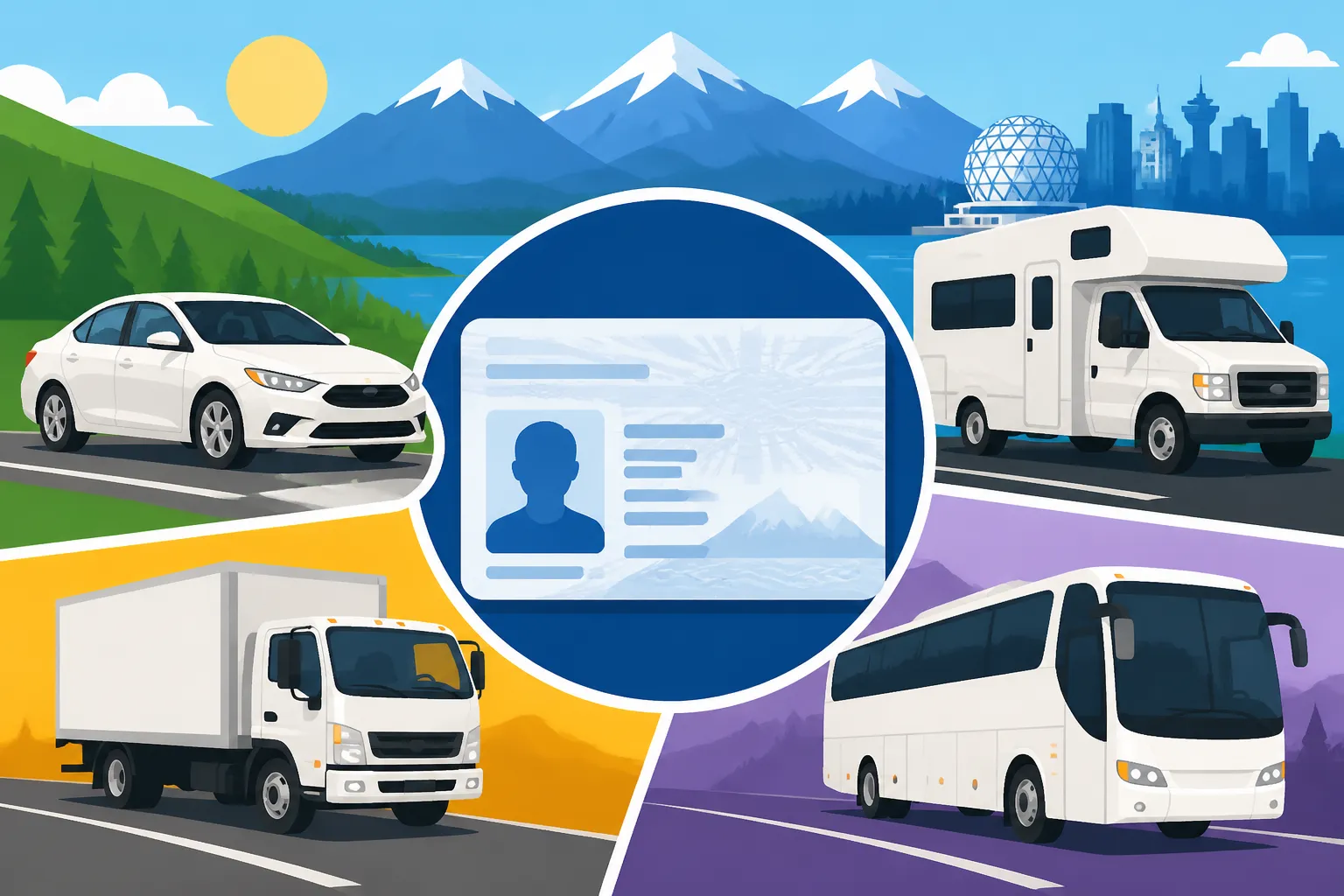
The main commercial classes are generally understood as follows:
- Class 1: for tractor-trailer combinations and other vehicles included in the class.
- Class 2: for buses and certain passenger-carrying vehicles.
- Class 3: for larger trucks and other vehicles covered by the class.
- Class 4: for certain passenger-carrying or special-purpose vehicles, with restricted and unrestricted forms.
These descriptions are broad. They do not replace the official class definitions or determine eligibility for a particular vehicle. For example, a vehicle used to carry passengers may have requirements that differ from those for a private car, even if the vehicle looks similar. A driver should identify the vehicle and intended use, then confirm the correct class before operating it.
Commercial licensing can involve additional steps beyond the class itself. Depending on the class and circumstances, an applicant may need to meet medical, knowledge, road-test, training, or experience requirements. Some commercial drivers also need an endorsement, such as one related to air brakes. A commercial licence can carry conditions that affect the vehicles a person may drive or the work they may perform.
If your work involves a truck, bus, taxi, ambulance, or other passenger-carrying vehicle, do not guess based on the vehicle’s size or the licence held by a co-worker. Start with Commercial Driver Licensing in B.C.: Classes 1 Through 4 and Which Commercial Driver Licence Class Do You Need in British Columbia?. For air-brake questions, see Air Brake Endorsements on British Columbia Driver’s Licences.
Commercial drivers should also check the vehicle’s inspection and operating requirements. Licensing is only one part of legal operation; insurance, vehicle condition, load, and other commercial rules may apply as well.
Choosing the right class and checking your licence
The safest way to identify the right class is to work from the vehicle and the task, not from a guess about the licence number.
- Identify the vehicle. Note what it is, how many passengers it carries, whether it is a motorcycle, and whether it has features such as air brakes.
- Describe how it will be used. Private driving, towing, carrying passengers for work, and commercial hauling can raise different requirements.
- Check the licence and any conditions. Look for the class, endorsements, and restrictions printed on the card or otherwise recorded in your licensing status.
- Confirm uncertain requirements with ICBC. If the vehicle or use is unusual, describe the specific setup rather than asking only whether a general class is “enough.”
- Complete any required licensing steps through the official agency. Tests, applications, renewals, and other licensing transactions are completed with ICBC, not through an independent guide.
A licence card can also serve as identification, but it is not the same thing as a non-driver identity card. Someone who does not drive may have other B.C. identification options. If that is your situation, British Columbia Photo ID Options for Non-Drivers explains the alternatives.
Common misunderstandings
“I have Class 5, so I can drive any vehicle.”
No. Class 5 covers many ordinary passenger vehicles, but it does not replace motorcycle or commercial classes, and restrictions may still apply.
“Class 7 is just a temporary card.”
Class 7 identifies the passenger-vehicle graduated licensing pathway. Learner and novice stages have different permissions and conditions.
“Class 8 means I am fully licensed to ride.”
No. Class 8 is the motorcycle learner class. Class 6 is the full motorcycle class, subject to the licensing requirements and any conditions.
“A commercial vehicle only needs a commercial licence if the driver is paid.”
Payment is not the only factor. The vehicle and its use help determine the class and any additional requirements.
“An endorsement and a class are the same thing.”
They are not. A class sets out a broad vehicle category, while an endorsement authorizes an additional feature or activity. A licence may require both.
If the class shown on your card does not seem to match the vehicle you intend to drive, pause before using it. Confirm the requirements with ICBC or the relevant official authority. A misunderstanding can lead to unsafe driving or licensing and insurance problems.
Frequently Asked Questions
Is Class 5 the same as a full licence in B.C.?
Class 5 is the full passenger-vehicle class. A driver usually reaches it after completing the applicable Class 7 stages and meeting the current eligibility requirements. Restrictions or conditions can still apply to an individual licence.
Can I drive a motorcycle with a Class 5 licence?
No. Class 5 does not replace the motorcycle licensing requirements. Class 8 is the motorcycle learner class, and Class 6 is the full motorcycle class.
What is the difference between Class 7 and Class 8?
Class 7 is associated with the graduated licensing stages for passenger vehicles. Class 8 is the learner class for motorcycles. They apply to different vehicle types and have different requirements.
Do I need a commercial class to drive a work vehicle?
Possibly. The vehicle, how it is configured, its passenger capacity, and its intended use all matter. Confirm the requirements for the specific vehicle with ICBC before driving it for work.
Where can I check the conditions on my licence?
Review the licence card and confirm any unclear class, restriction, or endorsement with ICBC. For information about a medical restriction or review, see Medical Fitness and Driving in B.C.: Rules and Reviews.
Disclaimer
This article is for general informational purposes only and does not constitute professional advice. Laws, prices and regulations vary by location and change over time. Consult a qualified professional for guidance on your specific situation. British Columbia Driver Guide is not a government agency and is not affiliated with any provincial motor vehicle department.